
Project Team Visits Solar Mini-Grid Communities in Ghana
Visiting solar mini-grids on Lake Volta
On Friday, 27th February, team members from Imperial College London, Centre for Environmental Policy, UENR and Strathmore University had the opportunity to visit the island community of Atigagome on Lake Volta to observe its solar mini-grid installation. The system with a generation capacity of 40.45 kWp with 161 kWh of battery storage, is one of the first five solar mini-grids developed to provide electricity access to island communities on Lake Volta, helping address the challenges of extending the national electricity grid to remote settlements.

The following day, the team visited the Kudorkope mini-grid, which has 54 kWp of solar PV capacity and 242 kWh of battery storage, and is also among the early systems deployed to electrify island communities in the lake region. Both systems have recently undergone upgrades to lithium-ion battery storage, improving reliability and operational performance.
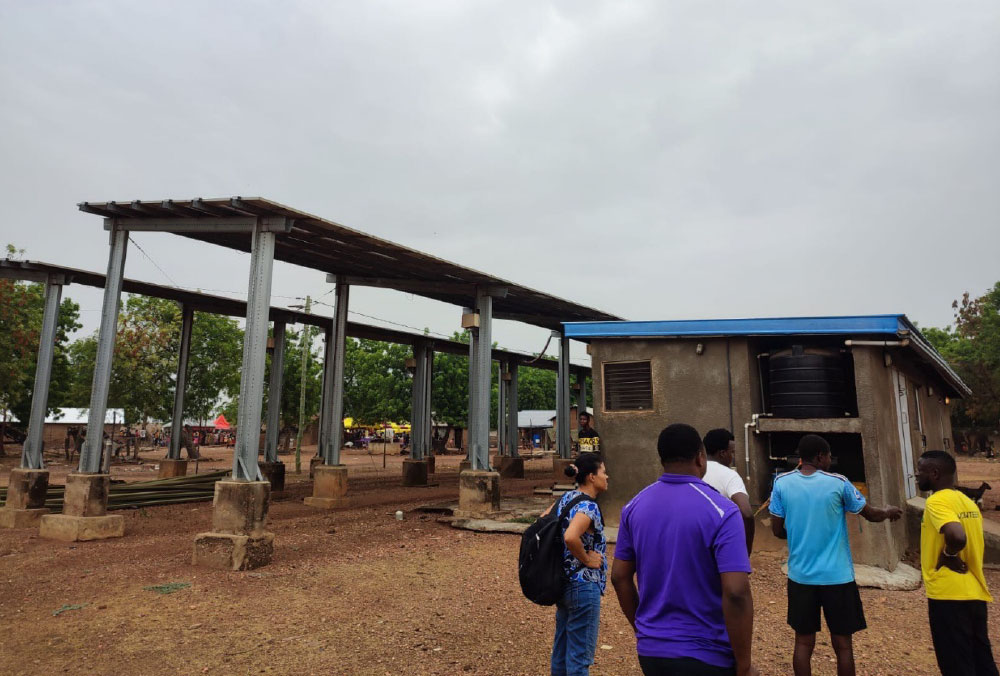
Both Atigagome and Kudorkope are fishing-based island communities, where decentralised renewable energy systems provide an important source of electricity for households, small businesses, and community services.
During the visits, the team engaged with local system caretakers to understand how electricity from the mini-grids is used in everyday activities. While mainly powering household level access to key energy services at different energy tiers, the mini-grids could potentially support a range of productive uses, including fish preservation and powering small-scale enterprises.
This visit contributed to the objectives of Work Package 0 (WP0) of the project, which focuses on assessing the socio-economic and techno-economic performance of solar mini-grids, including their potential to support community development and enable productive uses of electricity.
Linking energy access, livelihoods and essential services
Across both the Lake Volta island communities and the CHPS health facilities in Bechem, the field visits highlighted how improved access to reliable and sustainable electricity can support not only household needs but also local livelihoods, healthcare delivery, and broader community development.
Insights gathered during the visit will help inform the next stages of the Moving IMPACT Project, supporting ongoing research into the project’s wider goal of exploring how integrating solar PV generation with agricultural activities, small-scale electric mobility, and national grid connections can strengthen the long-term economic viability of rural mini-grids.

Published:
16th March 2026
